Friday, November 4, 2016

Who's your favorite?

We never want to pick favorites among our children, but it can be hard sometimes. Even if you don't show preferential treatment, their behaviors can definitely endear one to you over the other.  This is especially true when you have to boys and one is four years old and one is two.

My wife is really struggling with this right now as Caveboy (4) is very sweet and helpful much of the time. Of course he has his tantrums from time to time, but Cavebaby (2) is a challenge on a whole different level.  We didn't really believe the terrible twos were a real thing when Caveboy was two.  Maybe this was because our attention we focused on keeping the new baby alive, but I think that he may have been less of a challenge.

He was definitely a more polite nurser.  Also my wife was working less, and not in graduate school at the time.  Now when she sees Cavebaby its at night, when he won't sleep, or when he is battling for control of the other nipple so that he can twiddle it like he's spinning a dreidel.

For the most part I have been more immune to these issues as it isn't my nipples getting ripped off, nor am I the one trying to squeeze in some studying after bedtime.  Also I may be more predisposed to enjoy how "spirited" he is.  I put that in quotes because Cavemom might describe him as "a little shit" once in awhile.

Of course we love our Cavebaby and we both do thoroughly enjoy what a unique soul he is turning out to be, but even I am not entirely immune to having a favorite momentarily.


It can be difficult, however, when one child is writing on the couch with marker...
The work of Cavebaby

...and the other is doing the dishes. 

Cavemom's favorite* (For now)


Also if you need to clean marker off your faux suede couch, isopropyl alcohol works great.  Don't use the soap that comes with the couch first.  That will just leave weird stains on the couch.  


Thursday, April 28, 2016

Busy Spring


I haven't posted in a couple of months.  I guess I haven't made this blog a priority.  As you parents know, the little ones can take up a lot of time, and of course there is getting the garden going.  I have again tackled some big, time consuming projects in the yard.  I always think that all I will have to do this next year is maintain my infrastructure, but then I think of something new to do.

Every weekend up through the last in April we ski at Arapaho Basin, where I teach.  I have yet to post about our experience with teaching our 3 year old to ski, and my thoughts on that.  The post is mostly written.  I will try to get it out soon.

Caveboy did get in several days of skiing at Arapaho Basin, and even a couple of day at Taos, New Mexico.

In the lift-line with Momma

I have posted a few pictures on the Facebook page, but I haven't yet written about this year's silly time-consuming project: fixing and expanding the hoop house.  The plastic ripped over the winter and I took this opportunity to expand.  I was lucky enough to trade for 30 feet of new plastic, but at 28 feet long I would need to make a wall on either end.  I saw something about building with wattle and daub, and cob earlier this year and decided it would be fun to build an earthen wall on the shady side of the structure.

I had no idea how much work it was to do this.  I don't know how many hours I spend mixing clay/dirt and straw, and piling it up. Part of the reason for doing it was that it would be cheaper than plywood, but the cheapest straw bales I could find were $8.50, and I needed two.  So right there I saved exactly no money.  But we all built some character.... and a little under half a wall.  It turns out that some light does enter from that side and I wanted to take advantage of that.  

The start of the wattle

Caveboy doesn't actually like touching mud. Is he really my boy?

Bam Bam likes the mud, until he realizes its all over his hands.  
The new look

The wall as I called it done.  It will be nice to have the fan for the heat of the summer. 
At three and a half, Caveboy is becoming a good help in the yard.  He can actually move a bit of dirt with his shovel and wheelbarrow, and cleared all these sticks for the wattle on the wall.


Turning the soil in the beds with his own shovel
Cleaning sticks for the wattle of the wattle and daub wall


Raising wild boys comes with its share of dangers, bangs and crashes.  Caveboy had his first couple of Urgent Care visits and his first stitches.  Funnily enough these came from wrestling with the baby and climbing out of the pool, and not from jumping sofa gaps or crashing his bike.  

Lets work on that pool exit

Bam Bam requires constant vigilance

This crash was no problem.  
Good times!
Bam Bam wants to ride


That's my quick update. I'll try to get more out soon.

-Skiing with a 3 year old
-Garden updates
-Thanksgiving trip
-Wild Boys


Thursday, January 7, 2016

Mexican Trip

I haven't written as much about being a parent as I probably advertised during my initial post, or my philosophies therein.  Here's a little story about our winter trip to the Riviera Maya to visit my parents.


One thing I really appreciate about my parents is that they have always encouraged me to be learning about the world around me, and to appreciate new things.  They are continuing to help me do this, and they are helping me to share this with my children.

When my Dad retired in 2007 my parents bought a small weekender trailer to travel for two years.  After four years in that little thing, they bought the big rig, and haven't looked back.  Almost every year since 2008 they have driven their rig to Mexico to spend the winter on the beach.  Three of those years they have flown the family in for a week to share in the fun.

The second rig, which now lies in Mexican scrap yards.  

This  year Caveboy is three and a half years old, and therefore becoming aware of his world.  He's technically been to Quintana Roo all three times we have been down, but once was as a raspberry-sized cluster of cells, and the second time as a 7 month old baby.  On this trip he got to grow so much, and experience in the real world, things that had only been imaginary to him before.

Caveboy two years ago.

Some highlights for Caveboy:

  • Dolphins, seals and the Sea Cow
  • Crabs
  • Breadnut Trees
  • Tower
  • Boat Ride
  • Floating
  • Waves
  • Daddy Dolphin
  • Grandpa's Orange Juice

Dolphins
Before the trip we talked about dolphins a little, not because we knew we would get to see any, but because he has a dolphin (and a crab) bath toy.  We had even started to talk about the differences between mammals and non-mammals.  He remembered that dolphins "have milk", but that fish don't have milk.

It is a totally different experience getting to see an animal in the flesh, especially when one hasn't seen Flipper.  Last year when Caveboy was two we took him to a local petting zoo where he got to see sheep for the first time.  He'd had toys of sheep, but most likely believed that sheep were only an inch and a half tall.  Boy was he excited to see how big and fluffy they actually were.

If you haven't taken your kids to the farm/petting zoo, I suggest you make a point of an outing  That day a first grade class was on their way in when a parent-chaperon asked one of the kids what his favorite farm animal was.  He answered "chickens, because they make milk"...

Dolphin at Puerta Aventuras
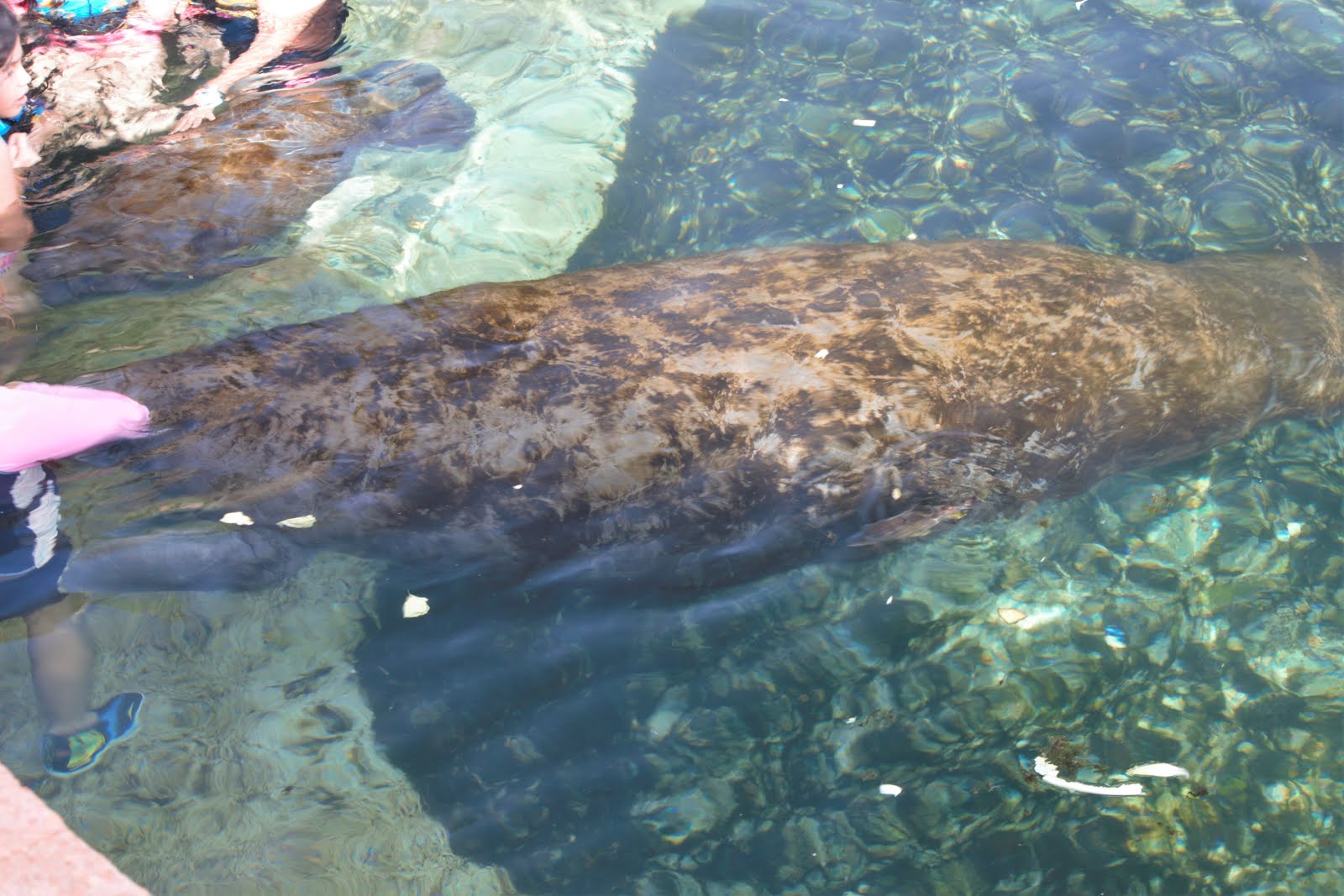
I had never seen dolphins in the flesh before either, but seeing them in captivity at Puerta Aventuras was a bit of a zoo experience.  The sea cow is a very interesting creature, and there were several people paying to feed them some romaine lettuce.
Sea Cow at Puerta Aventuras
Crabs were another animal that we got to see plenty of.  Hermit crabs hang round the trailers where my parents park.  They are the beaches little composters, eating the scraps accidentally, or intentionally by the locals.  Caveyboy never got quite brave enough to touch one, but he let us know each time he saw one.

The Breadnut Tree
One difficulty with traveling with small children is in how to plan activities that are fun for the whole family.  How can a hike through jungle, and a visit to the Mayan ruins at Muyil be fun for a three year old? Making an adventure out of it helps.

Babies dig culture too.
We took a guided tour with Miguel from Kan Tours, who has been a friend to my parents since their first trip to the Yucatan.  Miguel is an intense and knowledgeable naturalist and environmentalist.  He very skillfully weaves together the cultural and natural aspects of the surroundings. He knows most of the birds in the area by their call, can talk at length about the history and usage of the local flora, and knows a lot about the archaeology and history of the Mayan people.

This can be a lot for a three year old to take in, but there is always something for everyone.  One tree in particular allowed Caveboy to participate in the adventure.  The Breadnut Tree, a very common ficus-looking tree, seemed to be uniformly scattered around the jungle.  After Miguel explained all the uses to us, I was able to engage Caveboy in finding as many Breadnuts as he could.  This kept him quite happy for most of the hiking portion of trip that day.  Of course we also looked for animal sign! He was able to recognize the same scat we see up in Colorado: fox.
Caveboy with his collection of Breadnuts.
  If you ever want to scare the heck out of yourself, help a three year old climb to the top of a rickety wooden tower, and back down.
At least he isn't worried.
Safely Down


Boat Ride
Caveboy has been on a boat, in Mexico, before....


...I doubt he remembers it.

We haven't done the best job of introducing the boys to water, so the boat trip into Sian Ka'an was a new adventure.  I thought we went pretty fast across the waves of the lagoon, but, Caveboy thought it was too slow.  Dad must be old.
Miguel is an awesome guide.  
It's great having Auntie E around to hold babies

Floating
As mentioned above, the boys aren't swimmers yet, so the float trip was a little bit of a concern for Caveboy.  He had to wear his PFD properly, which is uncomfortable for floating.  The rest of us sat on them like diapers.  Luckily Cavebaby fell asleep in his Auntie's arms, and slept in the boat with Grandpa while the rest of us floated into the Sian Ka'an biosphere.

The whole trip was a great introduction to water play, and this was another, fun aspect of it.  In addition to floating, we could see fish in the crystal clear water, and many types of birds.

Floating in the canal.
Fish no have milk 

Finding Fish on the walk back to the boats

Do you remember the first time you got beat down by the ocean? I suppose I don't, though I'm sure the waves on Daejeon beach in South Korea must have sucked me under more than once when I was five years old.  Caveboy might not remember his first altercation with the rumbling sea, but I won't forget it.

Getting Bold (Grandpa just off camera)
The surf was too rough for snorkeling, and not quite big enough for surfing,but it was perfect for a three-year-old to learn to respect the sea.  He started out respectably timid, running away from the diminishing foam that spreads itself thin up the crushed coral sand.  During the first day he spent a fair amount of time being held by Auntie E out in the rolling waves.  I could tell he was nervous, but he was enjoying himself as well.

During the first afternoon he began to venture just to where the breakers would make balance a little hard, and then turn back.  By that third morning he got a little too bold.  Parents, grandparents, and Auntie E were ever present, so we felt comfortable letting the sea earn his respect.


Big Wave!
He walked out with Grandpa at his side, and Mommy lurking secretly up the beach from him.  Both cautiously and confidently he strode into the water.  One wave knocked him back a bit, but he kept his composure and sallied on.  Finally when he was just over waist deep in the surf the big one came and swept him back, and dunked him before leaving him sitting in the calm of the apex.  He looked surprised, but not (too) scared.  He now knew that there were limits.  

Whoosh!


Daddy Dolphin
Part of learning about water is to first observe how other people behave in the water.  He got to see us snorkel, and swim around in the sea and cenotes.  He even got to see Uncle Kid and I do some cliff diving.  Every time I surfaced from a dive he said something about "Daddy Dolphin".  

Clapping for Uncle Kid's first jump into Cristalino Cenote. 


Daddy Dolphin Waiting to attack (Photo: Grandma)

Grandpa's Orange Juice
One of the greatest things about the tropics is how much fresh fruit is available. Most kids can probably guess that orange juice comes from oranges, even if they think that milk comes from chickens, but its another thing to actually make your own orange juice.  The first time I had fresh squeezed orange juice I was 15, and I remember being really surprised at how much better it tastes than juice from the store.  Caveboy now knows about real orange juice.  Of course he believes that it is made exclusively by Grandpa.  

Grandpa at his orange juice station.

Trips like this are filled with days that are at once lazy and relaxing, and packed with adventure and learning for young and old alike. In addition to all the new experiences Caveboy had, Bam Bam (formerly known as Cave Baby) had his first ocean experience, I learned how to free dive to 12 meters, and Uncle Kid learned that mammals move their flippers up and down, and that fish flip from side to side.  


I love watching this guy grow.
A boy and his beach

Tuesday, January 5, 2016

Is My Child Ready To Ski?

"I got Timmy on skis at 18 months." "Maddie was skiing blues at 2." If you are a skier, you have probably heard some parents "proudly sharing" the age at which they first got their children on skis. And if you are a parent, or aspiring parent, who skis you have probably wondered what is the right approach to introducing your own children to the slopes.


How old should my child be? How will I know when she is ready to ski?
Is Caveboy (3.5 years, 2.5 year when I started this post!) ready to ski? Maybe.


To start out with you should probably try to ignore or try to filter through what other parents tell you about how early their children started skiing.  Focus on your own child's wants, motivations, and abilities. It can be easy to get excited to introduce your children to something that you enjoy so much, but try to remember that this will be their adventure, not yours.  I have been teaching children to ski since 2005, and even with the experience to know what it really takes to get a kid skiing and loving it, I still find myself wanting to get Caveboy out there right now.

I started this post at the end of the 2015 ski season, and I think it's about time I finished it.  Caveboy has been on the snow a couple of times now, and I will try to keep you up on how that is going as I give my opinions on how and when to start skiing.

For most children and circumstances the absolute earliest I would start your child skiing is kindergarten.

I'll start with the optimal, but keep reading past this before making the decision to wait.  Your families circumstances (access to skiing, etc.) in addition to you ability to afford lessons and your child's individual aptitudes are all part of the consideration. I will talk about the best ways to help your pre-school age children learn to ski in a later post.

For most children and circumstances the absolute earliest I would start your child skiing is kindergarten (between 5 and 6 years old). If you have a child of this age I am sure you have seen their global capabilities explode since starting kindergarten or first grade.  They are becoming very aware of their surroundings, their use and understanding of language has become on par with some adults you know, and physically they have become quite strong and agile.  For some people who don't play sports later, this may be the most fit they will ever be.

Sure there is something to be retained from skiing at four, or even three, but I have often seen that a five year old can catch up to kids who have been introduced to skiing at three or four years old in only a couple of weekends.  This is mostly due to the fact that the four year old likely only skied on the hill a couple of times, and of course they were not as strong and coordinated as they are now.  They didn't really learn that much.

The other reason that the five-year-old newbie catches up quickly is that 99% of the time the younger skier was over terrained and has developed bad, defensive skiing habits, that are very hard to break.  Conversely the five-year-old newbie, who is stronger, more patient, and better at learning physically and cognitively, and is more attuned affectively, is able to learn and perform proper fundamentals on their first day of the season.

...you have now put yourself in the same space as that Dad who hauls their kid to the top of the bunny hill and yells "Pizza Pizza Pizza!!!" at their back as they torpedo through my class and out into the parking lot.

If you get your three year old stuck in that power wedge their first season, it may take years to break them out of it.  Sure it's fun to brag that they got down that really steep green (Sundance at the Basin) stuck in the power wedge, but now you can probably be assured that your child will still be skiing like that at seven.  Even if you were smart enough to put your child in lessons, or introduce them slowly, you have now put yourself in the same space as that Dad who hauls their kid to the top of the bunny hill and yells "Pizza Pizza Pizza!!!" at their back as they torpedo through my class and out into the parking lot.  After all, that's how you learned to ski, and it totally worked.

If you don't ski every weekend it is probably best to wait until your children are at least five years old and in kindergarten or first grade to introduce them to skiing.  It will be more fun because they will learn faster, and they will be more in charge of their own adventure.

....now if you live near enough to you ski area, and will be up nearly every weekend, and have the time/money/patience, you can totally get your pre-school age kids skiing.  More on that next week.

I will also write a bit on how to prepare your kids for learning to ski, and a bit on how to teach them yourself (not recommended, but you'll still do it).


Wednesday, July 29, 2015

Garden Babies: Garden Update 3

Raspberries planted this year have produced an unexpectedly good yield.  Caveboy approves. 
Summertime, and the food is easy.  My oldest son is wandering the yard, foraging for raspberries and grazing on chard. It's a funny thing for a 3 year old to be into, but I'll often see him wandering around with a big red and green leaf in his hand.  This is what I was hoping for when I cranked up the size and scope of my garden after he was born.


Last year, as he turned two, the only food in the garden that was ready for him to pick and eat were the tomatoes in the hoop house.  And eat them he did.  My wife assumed that we didn't get many tomatoes last year, and the yield wasn't what it could have been had I not killed 2/3 of the plants, but the rest were victims of the Caveboy.
Sungold tomatoes from 2014.  This variety is great for children to forage for. No doubt this one was eaten by Caveboy shortly after this picture was taken.  

Next year the younger child will be almost two years old, and there will be so much more to eat. Those raspberry plants, pillaged from a patch that grew out of someone's yard to takeover a public area, will be in their second year.  In addition the strawberries I planted under them will start to produce fruit, as will the haskap and red currant bushes.

Two rows of berries will become at least 4 when the hugel beds, now covered in squash and corn, are conditioned for shrub growth.  Maybe I won't even have to prepare meals for my kids next July and August. 
Foraging and gathering seem to be natural activities for children, and they probably should be. Our forest dwelling ape ancestors had to forage for their food, and the need to gather likely contributed to bipedalism when climate change removed forest from the equation and left our ancestors in open woodlands, or savannas.

Our 10 month old has recently become bipedal, and this of course allows him to gather thing from one part of the house, and move them to another, and to run towards the edge of the deck causing multiple panics a day for us parents.

I would definitely encourage anyone with even a brownish green thumb to plant some permanent, edible plants.  Much of what I have planted will need very little water or care once it is established. A 25 foot row of raspberries can produce up to 25 pounds of berries in a year.


Tuesday, July 21, 2015

July Garden Update: This Year's Successes

Since I didn't get around to updating in June, the garden successes are for July.  And it's a good thing I waited until July so I could see how great some of these things have been.

Hydroponics
I am doing two things differently this year.  Previously I used pea gravel, and it did work fine. However I found it difficult to clean at the end of the season, and new pea gravel has so much sand and silt in it, it is also hard to clean to prepare it the first time.  I decided that I would try larger gravel, so that I wouldn't have to clean it as much on either end.  


Tomato roots growing down into the gravel.  The foil keeps light off the gravel, preventing algae growth and overheating. 
This seems to be working great.  My tomatoes are much better off than they were last year, but I will attribute that to not making some of the same rookie mistakes I made last year which damaged my plants.

Tomatoes getting big, quickly.
Notice the fan in the background.  That is another alteration this year.  It can get very hot in the hoophouse, which in turn can prevent tomatoes from pollinating.  I keep this fan on during hot days to keep air moving across the top.  It can also help to keep dew from settling on the leaves overnight.  
Woodchip Hydro?
I know that a lot of people who grow hydroponically use coco coir, shredded coconut husks, as a grow medium.  It is expensive, but hold water longer and therefore doesn't put you at risk of losing your crop if the electricity goes off one afternoon.  The problem for me is that it is expensive.  I decided to look up why growing in wood chips is not doable.  It turns out, that it is.  So I planted one tomato in wood chips, which I only water once a week.

Wood chips seem to be growing a health tomato plan.  
Woodchips are very often free. You can get them in Larimer County from the dump, or at the transfer station behind Rivendell School.

Wicking Buckets
I am continuing from last year where they seemed to keep up with the hydroponic tomatoes.  However not that I haven't over flooded or dried out the hydro plants a couple of times, I can really see the difference.  The do grow well in the buckets, and likely use less water than plants grown in the ground, but they don't compare to hydroponic tomatoes.  Not yet at least.  I probably need to work on my soil mixture.

A wicking bucket is a great idea for a low water use, container garden. 

The Wicking Bed
Now that it is July, and I have used the buckwheat to condition the soil to correct my mistakes of over amending, I am moving the wicking bed over to the success column.

I only have three plant in it, because I wasn't sure it was going to be ok, but they are doing great and I never have to water them, since the reservoir collects rain water from the top of the hoop house every time it rains.

Wicking bed with two peppers and an eggplant, and the remnants of the buckwheat.  

Coco Coir
"I thought you said you don't buy that?" I don't, but if you happen to live somewhere where medical (or even recreational) cannabis is legal there is likely a huge supply of free, once used coco out there.  Coco can be use many time for hydroponics, but since cannabis is such a high dollar crop, most growers only use it once and then throw it away.  Many don't know what to do with it.

I may use it next year for my tomatoes, but I have already used it as a soil amendment, and mulch.  Here in Northern Colorado we have a lot of clay in our soil, so an amendment like coco is a great way to loosen it up, and add some organic matter.  It rots slowly, so you don't have as much of a concern with nitrogen uptake as you might adding something woodier.  Also, since it has been fed for hydroponic use, you will be adding a great mixture of plant-ready nutrients to your soil.

Yep, they would just throw that out.  Mulch this year, in the soil next year.  
Permaculture
I have put together a couple of areas in my yard that are meant to be "extra sustainable."  These have been fun experiments, and are working pretty well.  Now that it is summer, and it isn't raining every day, one of the areas that was part of a failure earlier has become a success.

The Squash Garden
Super water efficient garden was not great when it rained a record amount, but it's awesome now
I have not had to water this area of the garden yet, but I did once just to empty my new rain barrel...
There are trenches, known as swales between each row, which I have filled with wood mulch.  The rows are covered with black plastic mulch.  When it rains water is held in the swales, and then wicked sideways into the garden beds.  The black plastic keeps moisture from rising vertically from the soil.  I have a soaker hose underneath with which I can passively water using the rain barrel.
It's sort of legal now, in Colorado
I'm sure there are places to get free barrels, but these were $3 each at Hageman's Earth Cycle.  They used to contain the clay-based dyes for their mulch.  You won't likely get all the dye out of the barrel, but it should be fine for watering the garden.  I won't put it into the hydroponic system, however. The spigot was $5, and the flexible downspout was about $8.  Add in a paint net and you are looking at $15-$20 for this 33 gallon barrel.  I hear you can often get 55 gallon drums for free from car washes.

Hugel Kultur
Bury some wood
Hugel Kultur is the practice of building garden beds on big mounds of dead wood.  The idea is that as the wood rots, great soil will be created with a lot of organic matter in it, and a great fungal environment for growing shrubs, bushes, and berries.  It is also supposed to hold moisture longer than dirt, and therefore require less watering. The very obvious problem with this is that the fungus responsible for rotting the wood will use up the available nitrogen while doing so.

While reading up on hugel kultur, I came across several instance of people who had bad "luck" using this method.  Many people try to overcome the nitrogen problem by adding manure. The problem with this idea is that that nitrogen won't be available to the plants until it also rots, and in the meantime they have probably added too much, therefore burning the plants root which are starved  of nitrogen in the first place.

How did I overcome this? Easy: urea.  "Hey, that's not organic." Nope, but point out to me where I said this was organic gardening.  I find it to be not too much of a sin against sustainability because, unlike potassium and phosphorous, nitrogen is not mined.  It s taken straight from the air using the Haber Process.  The sustainability argument against the Haber Process is that natural gas is often used as a catalyst.  I am ok with this.

I did add some chicken poop in with the wood, which will break down over the years and provide a lot of nitrogen, but I added enough this year to feed corn. I used corn so, along with the squash planted under it, partly because its roots will get down in and amongst the rotting wood to help it on its way.  Also it is a high nitrogen use, and so will use much of the nitrogen I added to prevent an over abundance when the nitrogen from the chicken manure becomes available, and subsequently when nitrogen is released by the dying fungus.

Cucumber on a hugel stack
This is a silly little experiment.  Playing of the ideas of hugel kultur and grow bags, I made a hugel stack.  I stacked some logs vertically, wrapped them in reemee, and added some dirt on top.  I water it by filling a juice carton top, and letting it drip.  It seems to be doing ok.  I did this just so I could see what the wood will look like after one growing season.


This post is getting long, so I will stop here.  Hopefully I can get part two out soon.

Also coming soon: It's squash season! Since I'm from New Mexico, that means calabasitas.  When my corn is ready, and some tomatoes, I will show you how to make the best, garden fresh, calabasitas ever.  

Tell me about your favorite summer garden meals.